

Keyu Jin
2023
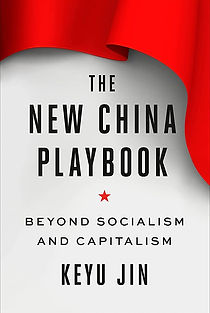
The New China Playbook
Every decade or so, the West produces a new theory of China. Keyu Jin's quietly rigorous book suggests the theories keep failing for the same reason: they are looking for a version of China that confirms what they already know.
The temptation, when confronted with China's economic trajectory, is to reach for a familiar story. The most common version runs something like this: a developing country opens its markets, a middle class emerges, prosperity follows, and the political system gradually liberalises to match. It is a narrative with a long track record in Western economic thinking, and it has been applied to China with considerable confidence and, repeatedly, considerable error.
Keyu Jin's book is in part a patient dismantling of that story. Jin — an economist at the London School of Economics, raised in China, educated in the United States — is positioned to see both the appeal of the Western framework and its limits. Her argument is not that China is exceptional in a way that puts it beyond analysis, but that it is different in ways that require different analytical tools. The country that emerged from Deng Xiaoping's reforms in the late 1970s is not a transitional economy on its way to becoming something recognisable. It is something that needs to be understood on its own terms.
The core of that difference lies in a relationship between state and market that resists the binary most Western observers instinctively apply. The government retains significant power to direct, regulate, and intervene — but it is the private sector that generates the majority of economic output, and China's younger entrepreneurs are increasingly defined by competitive drive and a desire to build genuinely superior products rather than by proximity to state patronage. This is not a contradiction to be resolved but a dynamic to be understood.
A useful comparison, and an instructive one, can be drawn with Japan. In the decades following Japan's postwar reconstruction, Western analysts were similarly confident they understood the trajectory — and similarly prone to misreading it. The cultural underpinnings of Japanese consumer behaviour, its patterns of saving and spending, the specific social logic of status and aspiration, consistently surprised observers who had mapped a Western consumer psychology onto a different set of values. The emergence of Japan's "Parasite Singles" in the 1990s — educated, employed individuals living with parents and spending heavily on personal consumption — looked anomalous through one lens and entirely coherent through another. China's own demographic peculiarities, shaped by decades of the one-child policy, produce consumer behaviours with their own internal logic: a generation of only children, intensively invested in by their families, navigating a fiercely competitive society in ways that defy easy generalisation.
What Jin asks of her reader is a willingness to examine the frameworks being used before applying them. That is, in a different register, the central challenge of cultural insight work. The country that keeps surprising Western analysts is not being unpredictable. It is operating according to a logic that the available tools were not built to see.


