

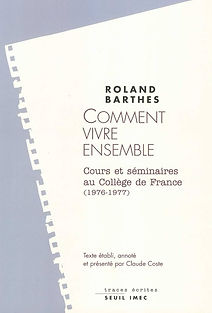
Roland Barthes
1977
Comment vivre ensemble
Roland Barthes was asking a question that turns out to be prior to empathy itself: how do we live alongside each other without either merging or colliding? The answer, he suggested, might be idiorrhythmy — and it might be impossible.
Idiorrhythmy is a monastic term. It describes a form of communal life in which each monk follows his own rhythm — his own hours of prayer, work, and solitude — within a shared space and a shared purpose. No one is required to synchronise completely with anyone else. The community exists, but it does not absorb. Barthes encountered the concept and found in it something he had been looking for: a name for the condition of coexistence that neither demands fusion nor tolerates complete withdrawal — the precise, difficult space between living together and living alone.
The fourteen lectures he gave at the Collège de France in 1977 circle this question from many angles — monasteries, desert hermits, bourgeois apartments, sanatoriums, a teenager fighting for a room of his own — without ever resolving it. The form mirrors the concept: fragments that coexist without merging, each keeping its own rhythm. But what Barthes keeps finding, beneath every example he examines, is the same structural problem. Every shared space contains, somewhere in its organisation, a decision about whose rhythm will prevail — and that decision is rarely acknowledged as the exercise of power it actually is. The monastery has an abbot. The apartment building has rules. Even Robinson Crusoe, alone on his island, reconstructs the hierarchies of the society he has lost: he cannot imagine solitude except in the terms his culture gave him.
Before we can ask how to understand each other, Barthes suggests, we need to ask whether we have created the conditions under which understanding — without absorption, erasure, or the management of power disguised as togetherness — is even possible. However, his conclusion is characteristically deflating. The idiorrhythmic project — a group whose purpose would be to perpetually resist becoming a group, to preserve individual rhythm within genuine community — is impossible. Superhuman, even.
Chantal Akerman's Jeanne Dielman (1975) shows what Barthes is describing without saying a word about it. The film follows three days in the life of a Brussels woman — widow, mother, occasional prostitute — whose existence is organised around an immaculate domestic ritual: meals prepared at exact times, surfaces cleaned in exact sequence, every hour accounted for. Akerman films it in real time, without commentary or close-up, as if the rhythm itself were the subject. When it finally breaks, the consequences are extreme. What the film makes visible is something Barthes could only circle: what it costs to live in a world where the conditions for idiorrhythmy were never offered to you in the first place.


