

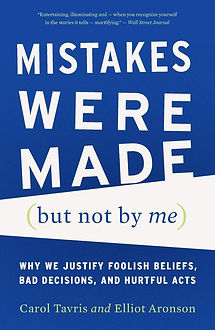
Carol Tavris and Elliot Aronson
2007
Mistakes Were Made (But Not by Me)
We think of memory as a record. Tavris and Aronson's argument is that it is closer to a draft — continuously revised to remain consistent with who we currently believe ourselves to be.
Cognitive dissonance — the discomfort produced when our actions, beliefs, or memories conflict with our self-image — is not a occasional experience. It is a continuous background condition of conscious life, and the mind manages it with considerable ingenuity. Tavris and Aronson's central argument is that the primary tool for managing it is not reconsideration but self-justification: the construction of narratives that make our past choices feel reasonable, our current beliefs feel consistent, and our mistakes feel like someone else's fault or nobody's fault or not really mistakes at all. The process is largely invisible to the person performing it.
Tavris and Aronson are particularly attentive to the memory functioning. Memory, they demonstrate, is not a static record that self-justification occasionally distorts. It is a dynamic reconstruction — an account assembled in the present from fragments of the past, shaped by current beliefs, subsequent experiences, and the narrative requirements of the self that is doing the remembering. Each time a memory is recalled it is subtly rewritten, incorporating new information, smoothing inconsistencies, adjusting details to fit the story that has since developed. The vivid, confident, detailed memory is not evidence of accuracy. It is evidence of a reconstruction that has been performed many times and has become fluent with repetition.
The sources of distortion are not dramatic. Family anecdotes, photographs, things read or heard afterward, the questions asked by researchers — all of these become incorporated into the reconstructed account, often indistinguishably from the original experience. A person who has been asked about a past purchase, a brand relationship, or a childhood experience is not retrieving a file. They are assembling an account in real time, using whatever materials are available, shaped by who they currently are and what they currently believe. The research context itself — the questions asked, the order in which they are asked, the framing applied — becomes part of the reconstruction it is trying to study.
This does not make retrospective research useless. It makes it more demanding. The account someone produces about a past experience is genuine testimony about how they have made sense of that experience over time — which is itself meaningful data, often more meaningful than a factual record would be. What they remember, and how they remember it, reveals the narrative they have constructed about themselves and their relationship to the thing being studied. The analyst's task is to read that narrative with the same careful attention recommended for Wilson's adaptive unconscious — attending not just to content but to shape, not just to what is remembered but to what has been smoothed over, revised, or rendered suspiciously coherent.


