

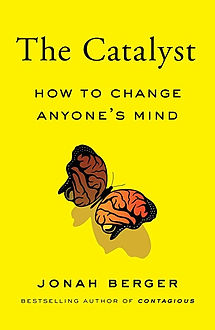
Jonah Berger
2020
The Catalyst
Behavioural science has produced some of the most useful observations about human decision-making of the last thirty years. It has also produced a genre of books that treats those observations as a universal toolkit — and that confidence is the problem.
There is a particular kind of confidence that behavioural science has earned over the past three decades — the confidence of a field that has repeatedly shown that human behaviour is predictable in ways that feel counterintuitive until they are demonstrated, and obvious once they are. Reactance, the endowment effect, loss aversion, social proof: these concepts have migrated from academic psychology into management consulting, public policy, and marketing with a fluency that suggests they describe something real and reliable about how people make decisions. Jonah Berger's The Catalyst is a skilled practitioner's guide to applying that toolkit to the specific problem of resistance to change — why people don't do what we want them to do, and what levers are available to shift that. It is also a precise example of what happens when findings leave their conditions of production behind.
The problem with the book is what it declines to discuss. Since roughly 2010, when a series of high-profile failures to replicate landmark findings began to accumulate, behavioural science has been working through what is now routinely called a replication crisis. Studies that had become foundational — on priming, ego depletion, power poses, certain applications of loss aversion — have failed to reproduce under more rigorous conditions. The crisis is not a scandal in the sense of deliberate fraud. It is something more structurally interesting: a field that developed under incentive systems that rewarded novel, counterintuitive findings and clean effect sizes, producing a literature in which the most striking results were the most likely to be published and the least likely to be robust. The findings that travel furthest — the ones that make it into books like The Catalyst — are precisely the ones most subject to this selection pressure.
Berger does not mention this. A book about how to change minds, written in confident declarative sentences about what human psychology does and does not do, is making an implicit claim about the reliability of its sources. That claim is stronger than the current state of the literature supports. The reader who applies these principles in practice is working with instruments whose calibration is genuinely uncertain — and the book gives them no way to know that.
The second limitation is temporal. Behavioural interventions are typically studied over short time horizons — the conditions under which it is practical to run controlled experiments. The Catalyst inherits that bias: its cases tend to show that a particular approach worked in a particular context, at a particular moment. What happens over longer cycles — whether the change holds, whether reactance resurfaces in different forms, whether the conditions that made the intervention effective persist — is largely outside the frame. Real organisational and social change operates on timescales that behavioural experiments are not designed to capture, and strategies built on short-term findings can produce unintended consequences that only become visible later.
It makes it a book one should read with a specific kind of alertness — attending to which findings have replicated, which rest on single studies, and where the confidence of the prose is outrunning the confidence of the evidence. That alertness is, in a different register, exactly what the hybrid methodology requires: not the rejection of behavioural tools, but a calibrated understanding of what they can and cannot reliably produce.


