

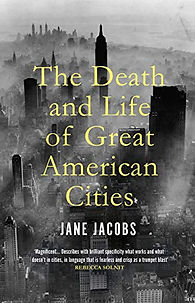
Jane Jacobs
1961
The Death and Life of Great American Cities
The most innovative neighbourhoods in the world are almost never planned. Jane Jacobs spent her life explaining why — and fighting the people who refused to believe it.
In the middle of the twentieth century, the dominant theory of urban improvement held that the old city was the problem. Its mixed-use streets were chaotic, its old buildings inefficient, its density unhygienic. The solution was clearance — tear down the existing fabric, separate the functions, build towers in parks, run highways through neighbourhoods, replace the organic complexity of the city that had grown over generations with something rational, modern, and planned. This was not a fringe position. It was the consensus of architects, planners, politicians, and philanthropists. Robert Moses built much of New York according to its logic, and cities across the world followed.
Jane Jacobs watched this happen from her street in Greenwich Village and concluded that the experts were wrong — not in their details but in their fundamental understanding of how cities work and what makes them alive. The Death and Life of Great American Cities, published in 1961, is her argument. It is also, unusually for a work of urban theory, a book written in anger — the precise, documented anger of someone who has watched valuable things being destroyed by people too confident in their own abstractions to notice what they were losing. Jacobs was not a credentialled planner. She was a journalist and a resident, and she brought to the question the only methodology that could have produced her conclusions: sustained, patient attention to what was actually happening on actual streets.
What she observed was that the neighbourhoods dismissed as slums or eyesores by the planners were, in many cases, functioning with remarkable vitality. The mixture of old and new buildings, of residents and businesses, of people on the street at different hours for different reasons — all of this produced something that no planned development could replicate: a dense, informal network of relationships, observations, and mutual dependencies that made streets safe, economies diverse, and communities resilient. Her concept of "eyes on the street" — the natural surveillance created when enough people have reasons to be in public spaces at enough different times — captured something the planners' models couldn't accommodate because it wasn't a feature you could design in. It emerged from complexity, and complexity was precisely what the renewal projects were eliminating.
Her argument about innovation is embedded in this larger vision. "New ideas must use old buildings," she wrote. Cheap, old, slightly run-down space is where new things start: the artist's studio, the small restaurant, the experimental workshop, the early-stage business that can't yet afford the rents of a successful neighbourhood. When cities clear their older fabric in favour of new development, they don't just destroy buildings. They destroy the economic conditions under which new things can begin.
This is a profound and underappreciated point about how innovation actually happens. It is not primarily a function of investment, planning, or the construction of innovation districts and technology campuses. It is a function of the kind of loose, affordable, mixed, walkable environments that allow different kinds of people with different kinds of ideas to collide with each other unpredictably. You cannot engineer serendipity. You can only create the conditions in which it becomes possible — or destroy them in the name of improvement.
The American Masters documentary on Jacobs brings her story to life with the footage and testimony her written work can only gesture toward — the streets she defended, the battles she fought, the highway that didn't get built through lower Manhattan because she and her neighbours refused to let it happen. It is a portrait of someone who understood that the most important acts of innovation are sometimes acts of preservation: the refusal to let the logic of efficiency erase what has taken generations to grow. Sometimes the most radical act is to look carefully at what already exists, understand why it works, and defend it against the people who are too busy building the future to notice what they're tearing down.


