

RADAR
Curated with taste, commented with conviction.

Strategy & Management
AI won’t replace workers — it will redefine what they’re capable of
McKinsey surveyed over 3,600 employees and executives on AI readiness at work — finding near-universal investment in AI, but only 1% of companies consider themselves truly mature. Readiness, it turns out, is complicated on all sides.
▸ Read more
The headline McKinsey wants you to take away: employees are ready, leaders are dragging their feet. Neat, actionable, perfect for a C-suite audience that needs a nudge. The actual data is less tidy.
Yes, employees are using AI regularly. Yes, they're more aware of its impact on their work than leaders assume. But 41% of the workforce remains apprehensive — not a footnote, nearly half. Trust concerns around accuracy and cybersecurity are widespread. And "using AI" in this context mostly means summarising. Helpful but hardly transformational.
The 1% maturity figure is the one worth sitting with. After years of investment, breathless coverage, and organisational pilots, one in a hundred companies feels AI is actually integrated into how they work. That's not a leadership problem. That's a signal that the gap between tool adoption and structural change is much wider — and stranger — than the substitution-or-augmentation debate captures.
What's missing from the McKinsey frame is that readiness isn't binary. Workers aren't simply ready or not — they're adapting unevenly, by role, by generation, by how much their job actually changes when AI enters the room. Millennials in managerial positions are apparently the missionaries here, bridging enthusiasm and anxiety across teams. Which suggests the real unit of change isn't the organisation or the individual, but something messier in between.
The real constraint the data reveals isn't leadership or culture or investment. It's imagination. Most people are using the most powerful cognitive tool in history to do slightly faster versions of tasks they were already doing. The gap between what AI can do and what people are asking it to do is not a technology problem. It's a problem of not yet knowing what to want.

Media & Culture
Everyone can be a creator now. That's the problem.
Business Insider reports on new CreatorIQ data showing that creator income inequality is widening: the top 10% of creators received 62% of all brand payments in 2025, up from 53% in 2023, while median per-campaign earnings declined from $3,500 to $3,000 over the same period — even as total payments to creators grew 59% year-over-year.
▸ Read more
The creator economy now has its own version of a stat that used to belong to countries: the top 1% take 21% of the money. Two years ago it was 15%. The numbers come from CreatorIQ's State of Creator Compensation report, which tracked 65,000 payments across three years. What they describe is not a market correcting. It's a market stratifying.
The paradox runs deeper than pay. The number of creators receiving payments through CreatorIQ more than doubled between 2023 and 2025. The IAB counts 1.5 million Americans working full-time as creators — 7.5 times more than in 2020. Brand investment in influencer marketing grew 171% year-over-year. By every aggregate measure, the industry is booming. But average earnings rose from $9,200 to $11,400 while the median — the number that describes what a typical creator actually earns — fell. It means the growth is being captured at the top and diluted at the bottom by the sheer number of people entering the market.
The platform data confirms the pattern from different angles. Socialinsider's analysis of over 2 million TikTok posts found views down 23% year-over-year and follower growth down 33%, with smaller accounts hit hardest — around 50% steeper decline — while brands increased posting frequency by 40%. On Instagram, engagement fell roughly 24% year-over-year across 35 million posts analysed, with average engagement rates dropping from 3.2% in 2022 to 2.3–2.6% in 2026.
Buffer's cross-platform study of 52 million posts showed Instagram's median engagement rate falling 26% in a single year. YouTube still rewards watch time generously for those who hold attention — but its 69 million active creators are up 11.6% year-over-year, and every algorithm update raises the completion-rate bar. In every case, the same pattern: more content going in, less visibility coming out per creator.
The platforms are not neutral arenas. They are designed to produce exactly this outcome. An algorithm that serves the most engaging content to the most people will, by definition, concentrate attention on fewer creators as total content supply rises. The Digiday piece on the disappearing creator middle class quoted one talent manager saying brand budgets now go to "the really in-demand creators" while mid-tier creators watch partnerships dry up. Meanwhile, the Influencer Marketing Factory's survey of 1,000 U.S. creators found that 48.7% earn under $10,000 a year. The report calls this "the emergence of a viable middle class." Whether earning under $10,000 annually from what 46.7% of respondents call their full-time occupation constitutes a middle class depends on a fairly generous definition of the term.
The creators who are navigating this successfully are the ones who stopped treating platforms as their business and started treating them as distribution for something they own — products, subscriptions, communities, or email lists they can export. The creator economy, in other words, is maturing the way every media economy eventually does: by rewarding the people who build infrastructure around their audience, not just content for it.

Research & Data
Sustainability spending is up. Sustainability claims are down
Unilever has formally retreated from the broad purpose-led branding model it pioneered, replacing 34 sustainability targets with 15 narrower goals tied to operational proof. The shift reflects a wider pattern: brands across sectors are pulling back from general sustainability language while largely maintaining their actual sustainability investment.
▸ Read more
Three years ago Unilever's reset would have generated a week of outraged LinkedIn posts. By 2026 it reads more like a building code update — procedural and already priced in by everyone except the people who wrote the original targets. Under Hein Schumacher, Unilever cut its virgin-plastic reduction target from 50% to 30%, pushed packaging deadlines to 2030-2035, and dropped its 2030 living-wage commitment entirely. It is a doctrine-level reversal at the company that did more than any other to institutionalise purpose-led branding. The EU's Empowering Consumers for the Green Transition Directive takes effect in September 2026 and bans words like "sustainable," "green," and "eco-friendly" in consumer-facing claims unless substantiated with lifecycle evidence.
The UK's Advertising Standards Authority got there first: in December 2025 it pulled Google ads from Nike, Lacoste, and Superdry for using "sustainable materials" and "sustainable clothing" without adequate proof. Lacoste had lifecycle assessments, organic cotton certifications, and a measured 19% improvement in raw-material impact. The ASA banned the ad anyway. Lacoste told the regulator that terms like "sustainable" are "very difficult to substantiate." That sentence is the whole era in miniature.
The instinct has been to read this as retreat. It isn't, mostly. GlobeScan's 2025 data shows that the share of consumers who reported seeing sustainability messaging from brands fell from 49% in 2023 to 36%. At the same time, around 85% of large companies are maintaining or increasing their sustainability spending. They are doing roughly the same work but saying considerably less about it — a behaviour now labelled "greenhushing," which sounds like a communications trend but is really a legal risk calculation. The problem is that silence erodes trust too: consumer confidence in sustainability messages dropped from 79% in 2022 to 65% in 2025. Brands that stopped talking to avoid being called greenwashers are now assumed to have nothing to say.
The consumer side is subtler than either camp admits. PwC reports an average willingness to pay a 9.7% premium for sustainably produced goods, which sounds like a mandate until you notice how it distributes. Deloitte finds the premium holds in low-cost, frequent-purchase categories — oat milk, soap, coffee — and weakens sharply for expensive, infrequent ones. Euromonitor adds that nearly 40% of consumers globally cite higher price as the main barrier. What this describes is not a values collapse but a daily budgeting exercise: people will absorb a sustainability premium on one item and offset it by choosing the cheapest option on the next three.
Unilever's old model assumed you could build a corporate story around purpose and let it radiate downward into brands. The new operating assumption is the reverse: proof has to start at the product, and the only claims worth making are the ones narrow enough to survive a regulator reading them literally.

Tech & Society
At CES 2026, the most talked-about chip was inside a LEGO brick
At CES 2026 — the annual Las Vegas showcase where the world's largest technology companies compete for attention — the product that generated the most genuine excitement was LEGO's new Smart Play system. No screen required.
▸ Read more
CES is where technology comes to announce itself. Eight years ago it was voice assistants. Four years ago it was the metaverse. This year it was full of AI, but the room responded most strongly to a Danish toy company that spent years making a brick that hums when you swing a lightsaber.
The Smart Brick is genuinely impressive engineering — a 4.1mm custom chip packed with accelerometers, magnetic field sensors, light sensors, a synthesiser and a miniature speaker, all inside a standard 2x4 brick that is backwards compatible with every LEGO set made since 1958. Swing a Star Wars lightsaber and it hums. Move the X-wing and the engines roar as lights fire across the hull. Put the policeman in the driver's seat and the chase begins. There is no app, no pairing, no screen. The reactions are generated live from motion, placement and context — not triggered from pre-recorded clips. LEGO describes this as its most significant evolution since the introduction of the Minifigure in 1978.
CES is dominated by companies racing to embed AI into everything — laptops, televisions, refrigerators, cars. The premise of the show is that more intelligence, more connectivity, and more software is always the direction of progress. Against that backdrop, LEGO arrived with a product whose central argument is almost the opposite: that the most valuable thing technology can do is disappear into a physical object and enhance what the hands are already doing. No screen. No app. No account.
Some critics worried the Smart Brick could undermine what was once great about LEGO — that children imagine the sounds and lights themselves. Others who got the sets early found the experience underwhelming: the sounds don't match Star Wars, the battery lasts under an hour. But at the most AI-saturated CES so far, the thing people talked about was a toy disconnected from AI.
Research & Data
The third place’s been always subsidised. Nobody agreed on who should pay now
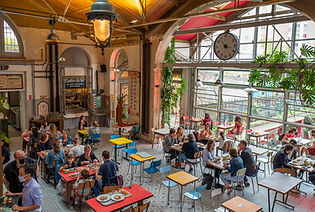
A Columbia Business School study put a number on something France has known instinctively for decades: neighbourhoods with a café — when none had existed before — saw 9 to 18% more new businesses per year over the following seven years. Cafés lower the cost of informal contact, and that is where networks form. France has been losing exactly that since 1960, going from 200,000 cafés to fewer than 40,000 today.
▸ Read more
Published initially in June 2024 (revised in January 2026), the paper landed in the same quarter that Starbucks reported its worst sales performance in years, replaced its CEO, and launched a turnaround plan called "Back to Starbucks" — an explicit attempt to recover the third-place identity the chain had spent a decade quietly dismantling. Outlet covers had been removed, soft chairs replaced by hard ones, drive-thru and mobile ordering now accounting for over 70% of transactions. The Columbia economists were measuring the social and economic value of something the company was simultaneously deciding it could no longer afford to provide for free.
Ray Oldenburg, who coined the term "third place" in his 1989 book The Great Good Place, was clear that the model depended on informality and low cost of entry — spaces where showing up was enough, and where no transaction was formally required to belong. What Starbucks understood, and what the NBER data confirms, is that the value produced by these spaces is real: denser networks, more ideas in circulation, more firms started. What neither Oldenburg nor Starbucks fully resolved is who absorbs the cost of the people who stay three hours on one coffee. That question has now been answered, at some locations in New York, with a membership fee charged separately from any drink — table access priced explicitly, belonging monetised directly. The third place, in other words, is becoming a second workspace.
In France the same collapse has been slower, older, and structurally different. France had 500,000 cafés in 1900 and fewer than 40,000 today, a decline driven by deindustrialisation, car culture sprawl, and the slow disappearance of the daily rituals — the espresso at the zinc counter, the lunch crowd, the après-work aperitif — things that made the business viable. The French bistro was never a brand strategy; it was civic infrastructure, and a community that lost its last one lost the room where its social life happened. In March 2025, a French lawmaker introduced a bill to ease alcohol licensing rules specifically to allow new bars to open in villages under 3,500 residents. Legislative action to restore something the market had removed. The association representing France's bistro owners has twice applied for UNESCO intangible cultural heritage status, watching French gastronomy accumulate distinctions while the neighbourhood institution that hosted it daily remains unrecognised.
The social cost of all this is not abstract. The 2023 US Surgeon General's advisory on loneliness — a public health document with peer-reviewed foundations — reported that roughly half of American adults were already experiencing loneliness before the pandemic began, with the highest rates among younger adults. The populations most likely to be in cafés with laptops are the ones registering the highest disconnection. The NBER paper shows that when a café opens in a neighbourhood that had none, startups follow as the networks form and the ideas flow. The question the paper does not answer, and that nobody has answered cleanly, is what happens to those networks when the café converts to mobile-only pickup, starts charging for the chair or simply closes.