

RADAR
Curated with taste, commented with conviction.
Tech & Society
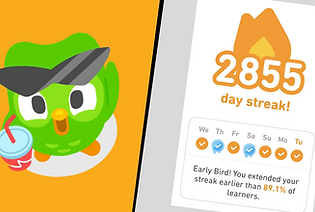
Duolingo built a habit machine. The owl just makes it lovable
Duolingo's "AI-first" memo triggered a brand meltdown — 400,000 TikTok followers gone, social media wiped — while the business boomed. The real threat isn't the internal pivot but AI making language learning unnecessary altogether. What might save Duolingo has nothing to do with its product roadmap.
▸ Read more
In February 2025, Duolingo killed Duo — its green owl mascot — in a hit-and-run involving a Tesla truck, generating over a billion organic impressions. It was the most controlled piece of manufactured grief in brand history. Three months later, they published a LinkedIn memo announcing it would become "AI-first," phase out contractors, and only hire where teams couldn't automate further. The top comment on TikTok — "Mama, may I have real people running the company" — got 69,000 likes. Duolingo wiped all its social media content. The brand that had spent years building the internet's most loyal and slightly unhinged fanbase managed, in a single memo, to make itself feel like the villain it had always pretended to be.
The CEO clarified, walked back, and clarified again. Duolingo launched 148 new language courses in under a year using generative AI — a process that would previously have taken decades. Earnings beat estimates. Daily active users grew 40% year-on-year. Stock rose 30% on the news. The backlash, TechCrunch noted drily, "didn't even matter." The brand took a hit, but the product got bigger and faster.
But the AI-first pivot obscured a more important question. Duolingo's business depends on people wanting to learn languages. Apple AirPods with live translation, Meta glasses, and Google Translate accessible anywhere are quietly making fluency unnecessary for the practical reasons most people start learning in the first place. And the current version of ChatGPT can teach them some basic Spanish. This is what investors were factoring in when the stock fell 80% from its May 2025 highs to February 2026.
The owl is the visible surface of something more substantial. Grammarly faces the same AI threat and has none of it — pure utility, fully exposed. What makes Duolingo harder to replace is that the owl embodies a method that actually works for habit formation in a way that an open-ended conversation with ChatGPT doesn't. ChatGPT is infinitely capable and infinitely unstructured. It will teach you Spanish if you know how to ask, how to progress, how to test yourself, how to stay motivated. Most people don't — which is exactly why Duolingo exists. Build something people don't want to lose, not because of what it does, but because of what it is and how it makes them feel about themselves while doing it.

Strategy & Management
Roomba invented the category. Chinese brands took it by cleaning better and watching less
In December 2025, iRobot — the company that invented the robot vacuum in 2002 and built it into a $1.6 billion business — filed for bankruptcy. It will be acquired by its own Chinese manufacturer. Chinese brands now hold nearly 70% of the global smart vacuum market. The story of how that happened is not primarily about price.
▸ Read more
iRobot's founder Colin Angle has a clear explanation for what went wrong: the Chinese fast follower. Companies like Roborock, Dreame, and Ecovacs entered the market after 2018 with a protected domestic market to cut their teeth on, iterated faster than iRobot could respond, and arrived in Western markets with better products at lower prices. That framing is accurate as far as it goes. It undersells the more specific story of what "better" actually meant — and why consumers chose it.
The first dimension is functional. iRobot stayed focused on vacuuming. Chinese competitors moved earlier and faster into mopping — a feature that sounds incremental but represents a fundamentally different product proposition. A robot that vacuums saves you one task. A robot that vacuums and mops replaces a cleaning session. Roborock, Dreame, and Ecovacs were building combination machines with self-emptying docks, auto-washing mop pads, and hot water cleaning cycles while Roomba was still refining its bump-and-turn navigation. iRobot adopted LiDAR navigation only in its 2025 lineup — years after Chinese brands had made it standard across mid-range models. By then, Chinese competitors had turned a premium feature into a floor expectation: budget models under $250 now ship with LiDAR navigation and self-emptying docks that were exclusive to $1,000+ devices in 2023.
The second dimension is privacy — and here the competitive logic is less obvious but more durable. iRobot's camera-based navigation created a persistent anxiety. In 2022, MIT Technology Review revealed that development Roombas had captured intimate images inside testers' homes which subsequently appeared on social media. The incident involved test units, not consumer products. The damage to trust was not contained to test units. The proposed Amazon acquisition amplified the concern: a company already accused of building surveillance infrastructure around its customers was about to own a robot that mapped the interior of your home room by room. European regulators opened an inquiry. The acquisition was blocked — partly on antitrust grounds, but the data anxiety it crystallised did not disappear with the deal. Chinese brands, whatever their own data practices, arrived without that specific story attached. Roborock's navigation relies primarily on LiDAR — a laser-based spatial sensing system that maps distance and geometry without capturing images of the people living in the home. The consumer proposition is meaningfully different: the robot knows where the sofa is without knowing what you look like on your sofa.
iRobot created a category and then held its position rather than developed it, while a cohort of competitors used a protected home market to fund rapid iteration and arrived in the West having already solved the problems Roomba hadn't. The bankruptcy is being read primarily as a geopolitical story — unfair competition, protected markets, the Amazon deal blocked at the wrong moment. It is also a product story: a pioneer that confused inventing a category with owning it, while the companies that came after kept asking what the product should actually do next.

Media & Culture
The Chinese soft power is on the march
Chinese consumer brands — Pop Mart, Luckin Coffee, Shein, Temu — are expanding aggressively into Western and emerging markets, carried by mobile-native business models, low prices, and cultural footholds built partly through TikTok. Geopolitical headwinds are real but so far insufficient to reverse the trend.
▸ Read more
Labubu is the most compelling cultural export China has produced in decades. It didn't need a narrative or government support. It just needed a blind box and a waiting list. Pop Mart's genius is in the mechanic — you don't buy a product, you buy anticipation, the small suspense of not knowing what's inside. And that feeling crosses borders effortlessly. It's on Lisa's handbag, in queues outside Ohio malls, on TikTok feeds across languages and time zones.
Soft power has always worked best when desire arrives before questions do — Levi's making Soviet-era teenagers dream of another world, anime giving a generation a new visual language, K-pop turning fans into participants. China spent decades as the world's factory floor, useful but not charismatic. What's shifted is that the brands arriving now use price to get in the room, and product to stay in it.
TikTok is the bigger story. With over a billion users worldwide, it is the platform through which an entire generation of young Westerners encountered a Chinese brand, without ever thinking of it that way. That's the most efficient soft power machine ever built: one that doesn't announce itself, doesn't ask for permission, and runs on dance videos and thirty-second recipes.
Luckin Coffee doesn't just do discounts — the app floods you with coupons so relentlessly that paying full price feels like a mistake. By the time you notice you've built a habit, you are ‘lucked’-in. In Brazil, BYD took a different route: it bought Ford's shuttered factory and is now building one of Latin America's largest EV plants on the site. Chinese expansion isn't just commercial. It's physical. They're occupying the infrastructure others left behind.
Young Americans and Europeans tend to view China more favourably than their parents. They think of Chinese products simply as apps. That's what soft power looks like when it's working: nebulous and unidentifiable. Whether it lasts is a different question. Retention rates tell a more sober story — Temu holds onto 60% of its users against Amazon's 93%, and Pop Mart's model lives and dies by the next drop. The brands that endure won't be the ones that arrived with the most hype. They'll be the ones that quietly became habits.
Research & Data
The goldfish stat was invented. The screen addiction is real
The OECD's Digital Well-being Report, drawing on a 14-country study from 2025, finds that digital engagement has complex effects on wellbeing — and that individuals spending over five hours a day on screens for personal use show markedly higher odds of poor mental health outcomes. Lifestyle factors (sleep, finances, physical activity) remain significant predictors, but screen time is not simply noise.
▸ Read more
The most-cited statistic in a decade of screen time panic — that humans now have an 8-second attention span, shorter than a goldfish — was sourced from a 2015 Microsoft Canada report citing an organisation called Statistic Brain. They fabricated the figure. There is no peer-reviewed study behind it. Goldfish, incidentally, can sustain attention considerably longer.
The OECD study is more careful and useful. Surveying over 14,000 individuals across 14 countries, it finds that the relationship between screen time and wellbeing is genuinely dose-dependent: moderate use (one to three hours daily) is not clearly harmful; more than five hours is. It also finds that what you do on a screen matters more than how long you do it — social connection and purposeful use behave differently than passive scrolling. Not all screen time is equal, which is the one thing the goldfish conversation was incapable of capturing.
But the OECD data doesn't let the optimists off either. Five hours of personal screen time is not an unusual day. And the category of "screen" now encompasses not just social media and streaming but AI assistants, which have their own particular capacity to occupy attention indefinitely and frictionlessly. Meanwhile, the Reverse Flynn Effect — a decline in measured IQ scores in several developed countries began reversing around 2010, which maps uncomfortably onto the spread of smartphones. The causal link remains contested as IQ tests themselves are being debated as valid cross-generational measures.
In response to all this, 114 education systems — 58% of countries worldwide, up from 24% in 2023 — have now introduced restrictions on phones in schools, according to UNESCO's Global Education Monitoring Report (March 2026). Australia went furthest, banning under-16s from holding social media accounts entirely, with fines up to $50M for platforms that fail to enforce it. These are not small regulatory nudges; they are structural interventions premised on a view of addictive design that the goldfish debate never quite got to. The science is still assembling its verdict. The policy moved without waiting.

Design & Creativity
The jeans may look similar. What each brand cuts from culture is not.
Three legacy denim brands — Levi's, Gap and American Eagle — simultaneously ran their most expensive campaigns in years, each built around a different theory of cultural relevance.
▸ Read more
Levi's didn't find Beyoncé. Beyoncé found Levi's — she named a song after them on Cowboy Carter, in part because the brand dressed Destiny's Child when high-end fashion wouldn't. The "Reiimagine" campaign understood what that history was worth: four chapters, each remaking a classic Levi's ad with Beyoncé in the role previously played by a male model, reversing the gender logic of every iconic denim image from the 1980s. The brand keeps this connection alive.
Gap's move is a deliberate attempt to create a new cultural moment that would resonate with today’s culture with little direct reference to the past. Katseye is a K-pop/American hybrid group co-created through a Hybe joint venture. The bet is that you can build the bridge to Gen Z from the ground up, installing your brand inside the architecture of a fandom before the fandom fully forms. The logic is sound: if you can't inherit cultural credibility, buy access to an audience that is still forming its loyalties. The question is whether discovery converts to anything durable, or whether the fan base follows the artist and leaves the brand behind.
American Eagle went a third way. "Sydney Sweeney Has Great Jeans" launched in July 2025 with the wordplay on "genes" that was called both deliberate and accidental. Either way, the result was 40 billion impressions, 790,000 new customers, a stock spike, a Trump endorsement, a counter-backlash, and another stock spike. Half of the country read it as a celebration of white identity while the other half provided the outrage that made it unmissable. That's not ambiguity but a calculated decision to profit from cultural backlash against progressive social movements.
Levi's, Gap and American Eagle are fighting the same enemy: Shein, Zara, Amazon, vintage — the complete commoditisation of denim as a product. In a world where functional product, trend-right cut and affordable price keep winning without a story attached, cultural positioning is what separates a brand from a private label. All three campaigns worked. Levi's women's business grew. Gap posted its best comparable sales quarter since 2017. American Eagle acquired 790,000 new customers in weeks. Each brand chose a different story to justify its own continued existence as a named thing in a market that would happily sell you the same jeans without one.