

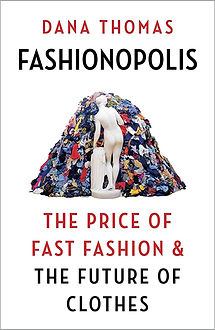
Dana Thomas
2019
Fashionopolis
You buy a t-shirt for ten euros. Someone made it. Something paid for the difference.
The fashion industry did not become what it is by accident. When Amancio Ortega built Zara into a global force in the late 1980s, he did something that changed the industry's fundamental logic: he collapsed the distance between design and shelf, turning fashion from a seasonal event into a continuous stream. The consequences of that shift — for labour, for the environment, for what clothes mean and how long they last — are what Dana Thomas spends Fashionopolis documenting.
The picture she assembles is damaging. Production outsourced to factories where safety standards are aspirational rather than enforced. Synthetic fabrics that shed microplastics into water systems with every wash, working their way through marine food chains in ways we are only beginning to understand. A creative economy in which designs move from runway to high street in weeks, with neither credit nor compensation to the people who originated them.
Some of the numbers that travel furthest from the book deserve a closer look, however. The claim that fashion accounts for roughly 10% of global carbon emissions has become one of the most cited statistics in sustainability discourse and one of the most contested. Depending on where you draw the system boundary, how you account for transport and retail, and which base year you use, estimates vary significantly. This does not make the industry's impact any less real. It does suggest that the conversation about fashion and climate is not always as well-grounded in data as its confidence implies — a problem that extends well beyond this book, and one worth holding onto when evaluating any sustainability claim.
The second half of Fashionopolis turns toward the slow fashion movement — smaller brands, conscious consumers, a growing interest in provenance, craft, and durability. Thomas presents this with genuine hope, and the examples she finds are real. But the behavioural gap that runs through any honest account of the sustainability crisis appears here too. The slow fashion movement is a meaningful cultural shift among a specific constituency — educated, urban, with the disposable income to make ethical consumption a viable choice. Meanwhile, the system it is pushing against continues to scale. More garments are produced globally each year than the year before. More are discarded faster. The consumers most affected by the labour conditions Thomas describes are often the same ones for whom fast fashion represents not irresponsibility but access. The critique of consumption as a driver of change has limits that Fashionopolis does not always sit with.
What the book does best is make the supply chain visible. Most of what we wear arrives at the point of purchase with its history erased — the factory, the worker, the water, the chemistry all rendered invisible by the distance between production and consumption. Thomas closes that distance, and that is genuinely valuable work. The question the book leaves open — how systems change when the people most able to change their behaviour represent a fraction of the market — is one that no individual book can answer. But it is the right question, and Fashionopolis earns its place in any collection serious about what sustainable futures would actually require.


