Research & Data
The third place’s been always subsidised. Nobody agreed on who should pay now
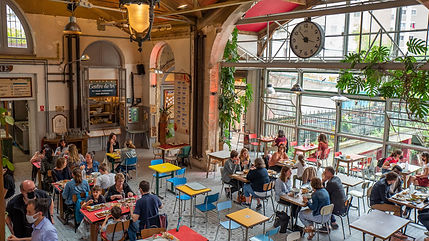
A Columbia Business School study put a number on something France has known instinctively for decades: neighbourhoods with a café — when none had existed before — saw 9 to 18% more new businesses per year over the following seven years. Cafés lower the cost of informal contact, and that is where networks form. France has been losing exactly that since 1960, going from 200,000 cafés to fewer than 40,000 today.
Published initially in June 2024 (revised in January 2026), the paper landed in the same quarter that Starbucks reported its worst sales performance in years, replaced its CEO, and launched a turnaround plan called "Back to Starbucks" — an explicit attempt to recover the third-place identity the chain had spent a decade quietly dismantling. Outlet covers had been removed, soft chairs replaced by hard ones, drive-thru and mobile ordering now accounting for over 70% of transactions. The Columbia economists were measuring the social and economic value of something the company was simultaneously deciding it could no longer afford to provide for free.
Ray Oldenburg, who coined the term "third place" in his 1989 book The Great Good Place, was clear that the model depended on informality and low cost of entry — spaces where showing up was enough, and where no transaction was formally required to belong. What Starbucks understood, and what the NBER data confirms, is that the value produced by these spaces is real: denser networks, more ideas in circulation, more firms started. What neither Oldenburg nor Starbucks fully resolved is who absorbs the cost of the people who stay three hours on one coffee. That question has now been answered, at some locations in New York, with a membership fee charged separately from any drink — table access priced explicitly, belonging monetised directly. The third place, in other words, is becoming a second workspace.
In France the same collapse has been slower, older, and structurally different. France had 500,000 cafés in 1900 and fewer than 40,000 today, a decline driven by deindustrialisation, car culture sprawl, and the slow disappearance of the daily rituals — the espresso at the zinc counter, the lunch crowd, the après-work aperitif — things that made the business viable. The French bistro was never a brand strategy; it was civic infrastructure, and a community that lost its last one lost the room where its social life happened. In March 2025, a French lawmaker introduced a bill to ease alcohol licensing rules specifically to allow new bars to open in villages under 3,500 residents. Legislative action to restore something the market had removed. The association representing France's bistro owners has twice applied for UNESCO intangible cultural heritage status, watching French gastronomy accumulate distinctions while the neighbourhood institution that hosted it daily remains unrecognised.
The social cost of all this is not abstract. The 2023 US Surgeon General's advisory on loneliness — a public health document with peer-reviewed foundations — reported that roughly half of American adults were already experiencing loneliness before the pandemic began, with the highest rates among younger adults. The populations most likely to be in cafés with laptops are the ones registering the highest disconnection. The NBER paper shows that when a café opens in a neighbourhood that had none, startups follow as the networks form and the ideas flow. The question the paper does not answer, and that nobody has answered cleanly, is what happens to those networks when the café converts to mobile-only pickup, starts charging for the chair or simply closes.